
You are halfway through writing a formal document and suddenly stop at the same word for the third time: is it “requester” or “requestor”? This small spelling question shows up in legal contracts, IT helpdesk tickets, and government procurement forms, and getting it wrong can make your writing look careless in front of the wrong people. Both words exist, both are used, but they do not belong in the same places. Understanding the difference between requester vs requestor is what separates polished professional writing from writing that just gets by.
This article breaks down exactly when to use each word, what they mean in formal and legal contexts, and gives you 29+ alternatives sorted by tone and situation. Whether you are writing a quick email or a binding contract, you will walk away knowing the right word every single time.
Quick Difference in Simple Words
Requester is the everyday word most people use.
Requestor is the formal, legal version. Both mean the same thing: someone who asks for something.
Requester vs Requestor: What’s the Difference?
Both words describe a person making a request, but they live in different worlds.
| Word | Used In | Tone |
| Requester | Everyday writing, emails, casual use | Informal |
| Requestor | Legal, government, procurement documents | Formal |
“Requester” follows standard English spelling rules. “Requestor” is a legal term that stuck around in official documents and contracts.
When Should You Use These Alternatives?
Use requester in daily life, business emails, and general writing.
Use requestor when writing legal contracts, government forms, or procurement documents.
Simple rule: if you’re not sure which to use, go with requester. It’s always correct and sounds natural to any reader.
27+ Other Ways to Say “Requester vs Requestor”
1. Requesting Party
Meaning: The person or group officially asking for something.
Tone: Formal and legal
Tip: Best for contracts and official documents.
Do: Use in legal agreements and formal paperwork.
Don’t: Use in casual emails or everyday conversation.
Examples:
- The requesting party must submit all documents by Friday.
- Both sides agreed the requesting party would bear the cost.
- The requesting party filed the form with the court.
- Our team will respond to the requesting party within 48 hours.
- The requesting party has the right to withdraw at any time.
2. Applicant
Meaning: Someone who formally applies for something like a job, loan, or permit.
Tone: Neutral to formal
Tip: Great for HR, admissions, and government forms.
Do: Use when someone is filling out an application.
Don’t: Use for informal or quick requests.
Examples:
- The applicant submitted all required documents on time.
- Each applicant will be contacted within five business days.
- The applicant must meet the age requirement to qualify.
- Our team reviewed every applicant carefully.
- The applicant was asked to attend a second interview.
3. Submitter
Meaning: Someone who sends or submits something for review or approval.
Tone: Neutral and technical
Tip: Works well in IT, publishing, and form-based systems.
Do: Use in digital platforms, portals, and ticketing systems.
Don’t: Use in spoken conversations as it can sound robotic.
Examples:
- The submitter will receive a confirmation email instantly.
- Each submitter must agree to the terms before sending.
- The submitter forgot to attach the required file.
- Only one submission per submitter is allowed.
- The submitter can track the status online.
4. Sender
Meaning: The person who sends a message, request, or package.
Tone: Casual to neutral
Tip: Perfect for emails, messages, and delivery contexts.
Do: Use in communication and logistics.
Don’t: Use in legal documents where precision is needed.
Examples:
- The sender’s email address was not recognized.
- Please ask the sender to resend the file in PDF format.
- The sender will be notified once the package is delivered.
- Our system blocked the sender due to spam detection.
- The sender left no return address on the envelope.
5. Petitioner
Meaning: Someone who formally requests something, often through a petition or court filing.
Tone: Very formal and legal
Tip: Use in court cases, government petitions, or official appeals.
Do: Use in legal filings, petitions, and formal hearings.
Don’t: Use in everyday office or business conversations.
Examples:
- The petitioner requested a hearing before the judge.
- The court ruled in favor of the petitioner.
- Each petitioner must sign the document in person.
- The petitioner filed for an extension last week.
- The petitioner’s claim was reviewed by the committee.
6. Inquirer
Meaning: Someone who asks questions or seeks information.
Tone: Neutral and professional
Tip: Works well in customer service and information-based contexts.
Do: Use when someone is asking for details or information.
Don’t: Use when someone is making a formal or legal demand.
Examples:
- The inquirer was directed to the right department.
- Our support team responded to every inquirer promptly.
- The inquirer asked about refund policies.
- Each inquirer gets a response within 24 hours.
- The inquirer seemed satisfied with the explanation.
7. Customer
Meaning: Someone who buys or uses a product or service.
Tone: Friendly and business-focused
Tip: Best for retail, sales, and service-based businesses.
Do: Use in business, marketing, and customer service.
Don’t: Use in legal or government documents.
Examples:
- The customer asked for a full refund.
- Every customer deserves a fast and helpful response.
- The customer left a five-star review after the fix.
- Our customer called twice about the same issue.
- We always put the customer’s needs first.
8. Client
Meaning: A person or company that pays for professional services.
Tone: Professional and business-friendly
Tip: Common in law firms, agencies, consulting, and freelancing.
Do: Use in professional service relationships.
Don’t: Use in casual retail or everyday shopping contexts.
Examples:
- The client approved the final design yesterday.
- Our client requested changes to the contract terms.
- The client meeting is scheduled for Monday morning.
- We delivered the project on time for the client.
- The client was happy with the final outcome.
9. End User
Meaning: The actual person who uses a product or system, not the buyer or developer.
Tone: Technical and neutral
Tip: Very common in IT, software, and product development.
Do: Use in tech, software documentation, and product design.
Don’t: Use in non-technical or general writing.
Examples:
- The end user found the interface confusing at first.
- We redesigned the app based on end user feedback.
- The end user does not need technical knowledge to operate it.
- Our goal is to make the experience smooth for the end user.
- The end user manual is available for free download.
10. User
Meaning: Anyone who uses a product, service, or system.
Tone: Casual and universal
Tip: Works in almost every context from apps to services.
Do: Use in digital products, platforms, and everyday writing.
Don’t: Overuse it in formal legal documents.
Examples:
- The user can reset their password at any time.
- Each user gets 5GB of free storage.
- The user reported a bug in the checkout page.
- New users receive a welcome email on sign-up.
- The user guide is simple and easy to follow.
11. Ticket Raiser
Meaning: Someone who creates a support or service ticket to report an issue.
Tone: Technical and workplace-specific
Tip: Common in IT helpdesks and customer support teams.
Do: Use in internal IT systems and support workflows.
Don’t: Use outside of tech or support environments.
Examples:
- The ticket raiser should describe the issue clearly.
- Our team contacted the ticket raiser within the hour.
- The ticket raiser forgot to mention the error code.
- Each ticket raiser gets an automatic reference number.
- The ticket raiser marked the issue as urgent.
12. Ticket Creator
Meaning: The person who opens a new support or service ticket in a system.
Tone: Technical and neutral
Tip: Same as ticket raiser but slightly more common in software platforms.
Do: Use in helpdesk, CRM, and IT support platforms.
Don’t: Use in client-facing formal documents.
Examples:
- The ticket creator can add attachments to their request.
- We notify the ticket creator when the issue is resolved.
- The ticket creator selected the wrong category at first.
- Any ticket creator can reopen a closed ticket.
- The ticket creator left detailed notes in the description.
13. Originator
Meaning: The person who starts or originates a request, process, or document.
Tone: Formal and professional
Tip: Great for workflows, banking, and official processes.
Do: Use in process documentation and financial transactions.
Don’t: Use in casual or informal communication.
Examples:
- The originator of the request must sign the form.
- The transaction originator will receive a receipt.
- The originator started the approval process yesterday.
- We need the originator’s signature to proceed.
- The originator can cancel the request before approval.
14. Initiator
Meaning: The person who kicks off or starts something, like a process or conversation.
Tone: Neutral to formal
Tip: Works well in project management and process flows.
Do: Use in workflows, meetings, and project documentation.
Don’t: Use when a more specific word fits better.
Examples:
- The initiator of the project set the deadline for June.
- The initiator must be present during the kickoff meeting.
- The system logs who the initiator of each request is.
- The initiator forgot to assign the task to anyone.
- As the initiator, you are responsible for follow-ups.
15. Requester (Preferred General Form)
Meaning: The standard everyday word for someone who makes a request.
Tone: Neutral and universally accepted
Tip: When in doubt, use this. It works everywhere.
Do: Use in emails, reports, business writing, and general communication.
Don’t: Replace it unnecessarily with complex alternatives.
Examples:
- The requester will be informed once the task is complete.
- Please ensure the requester gets a copy of the response.
- The requester submitted their form through the portal.
- Our team always keeps the requester updated.
- The requester asked for the report by end of day.
16. Requestor (Formal/Technical Variant)
Meaning: A formal or legal variant of “requester” used in official and technical contexts.
Tone: Formal and legal
Tip: Stick to legal, procurement, and government documents only.
Do: Use in contracts, tenders, and official government forms.
Don’t: Use in regular business emails or informal writing.
Examples:
- The requestor must provide valid identification.
- All requestors are subject to a background check.
- The requestor submitted the procurement form on time.
- The contract clearly names the requestor and the provider.
- The requestor’s details must be verified before approval.
17. Demanding Party
Meaning: The party making a strong or formal demand, often in legal or negotiation contexts.
Tone: Very formal and assertive
Tip: Use in dispute resolution, legal claims, and formal negotiations.
Do: Use in legal and formal dispute settings.
Don’t: Use in regular business or friendly communication.
Examples:
- The demanding party insisted on a full refund.
- The court asked the demanding party to provide evidence.
- The demanding party refused to accept partial payment.
- The legal team represented the demanding party.
- The demanding party filed a formal complaint.
18. Person Requesting
Meaning: A simple, plain-English way to describe whoever is making the request.
Tone: Casual and clear
Tip: Use when you want plain language that everyone understands.
Do: Use in plain-language guides, FAQs, and simple instructions.
Don’t: Use in formal legal documents where precise terms are needed.
Examples:
- The person requesting access must fill out the form.
- We will contact the person requesting within two days.
- The person requesting the report should email HR directly.
- Make sure the person requesting is eligible to apply.
- The person requesting can withdraw their application anytime.
19. Service Requester
Meaning: Someone who asks for a specific service, often in IT or customer support.
Tone: Professional and technical
Tip: Perfect for IT service management and ITSM tools like ServiceNow.
Do: Use in service management, IT support, and helpdesk environments.
Don’t: Use outside of service-related professional contexts.
Examples:
- The service requester opened a new ticket this morning.
- Our team resolved the service requester’s issue in one hour.
- The service requester needs to provide their employee ID.
- Each service requester is assigned a dedicated agent.
- The service requester rated the support experience highly.
20. Complainant
Meaning: A person who formally raises a complaint or grievance.
Tone: Formal and legal
Tip: Common in HR, legal, and regulatory environments.
Do: Use when someone has officially raised a complaint.
Don’t: Use for general requests that are not complaints.
Examples:
- The complainant filed the grievance with HR last week.
- The panel will hear from the complainant first.
- The complainant requested anonymity throughout the process.
- The company responded to the complainant within three days.
- The complainant’s identity was kept confidential.
21. Claimant
Meaning: Someone who claims a right, benefit, or compensation they believe they are entitled to.
Tone: Formal and legal
Tip: Common in insurance, law, and benefits systems.
Do: Use in insurance claims, legal cases, and benefit applications.
Don’t: Use in everyday requests or general communication.
Examples:
- The claimant submitted all required medical documents.
- The insurance company contacted the claimant directly.
- The claimant was awarded compensation after the hearing.
- Each claimant must prove their eligibility for the benefit.
- The claimant’s case will be reviewed within 30 days.
22. Beneficiary
Meaning: A person who receives or benefits from something like a policy, will, or program.
Tone: Formal and legal
Tip: Used in insurance, wills, trusts, and aid programs.
Do: Use when someone is set to receive a benefit or payout.
Don’t: Use when the person is simply asking, not receiving.
Examples:
- The beneficiary will receive the payout within 10 days.
- She was listed as the primary beneficiary in the will.
- The beneficiary must provide a valid ID to claim.
- The program supports the beneficiary with monthly aid.
- The bank notified the beneficiary of the fund transfer.
23. Stakeholder
Meaning: Anyone who has an interest or stake in a project, decision, or outcome.
Tone: Professional and business-focused
Tip: Great for project management, strategy, and corporate communication.
Do: Use in business planning, project documentation, and meetings.
Don’t: Use when referring to a single person making a simple request.
Examples:
- Each stakeholder was invited to share their feedback.
- The project manager kept all stakeholders informed.
- A stakeholder meeting was held before the launch.
- The CEO is the key stakeholder in this decision.
- We gathered input from all stakeholders before finalizing the plan.
24. Buyer
Meaning: A person who purchases goods or services.
Tone: Casual to business-friendly
Tip: Works best in sales, e-commerce, and retail contexts.
Do: Use in sales, purchasing, and commercial transactions.
Don’t: Use in legal or non-commercial service contexts.
Examples:
- The buyer requested a discount on bulk orders.
- Our team contacted the buyer after the order was placed.
- The buyer left positive feedback on the product page.
- The buyer has 14 days to return the item.
- The buyer signed the purchase agreement this morning.
25. Purchaser
Meaning: A more formal word for buyer, often used in contracts and official documents.
Tone: Formal and contractual
Tip: Use in purchase agreements, tenders, and legal transactions.
Do: Use in formal contracts, procurement, and official documents.
Don’t: Use in casual retail or everyday sales conversations.
Examples:
- The purchaser agreed to the terms and conditions.
- The purchaser must pay the full amount within 30 days.
- The purchaser requested a modification to the contract.
- Both the seller and the purchaser signed the agreement.
- The purchaser has the right to inspect the goods before delivery.
26. Ordering Party
Meaning: The party that places an official order for goods or services.
Tone: Formal and commercial
Tip: Used in procurement, logistics, and supply chain documentation.
Do: Use in purchase orders, supply agreements, and logistics.
Don’t: Use in casual business communication.
Examples:
- The ordering party must confirm the quantity before shipping.
- The invoice is addressed to the ordering party.
- The ordering party requested delivery within five business days.
- The supplier contacted the ordering party to confirm the order.
- The ordering party has the right to cancel before dispatch.
27. Authorized Representative
Meaning: A person officially allowed to act or make requests on behalf of someone else or an organization.
Tone: Very formal and legal
Tip: Common in legal, corporate, and government settings.
Do: Use when someone is acting with official authority on behalf of another.
Don’t: Use for individuals making personal requests.
Examples:
- The authorized representative signed the contract on behalf of the company.
- Only an authorized representative can submit this form.
- The bank verified the authorized representative’s credentials.
- The authorized representative attended the hearing in place of the CEO.
- Please ensure your authorized representative carries valid identification.
28. Requesting Individual
Meaning: A plain and clear term for the specific person making a request.
Tone: Neutral and professional
Tip: Works well in formal reports and policy documents where clarity matters.
Do: Use in policy writing, formal reports, and process documentation.
Don’t: Use when a simpler word like “requester” works just as well.
Examples:
- The requesting individual must complete the form in full.
- Our team will follow up with the requesting individual shortly.
- The requesting individual provided all necessary attachments.
- The system records the name of the requesting individual automatically.
- The requesting individual can check the status online.
29. Request Originator
Meaning: The person who first creates or starts a request in a system or process.
Tone: Technical and professional
Tip: Common in workflow tools, ERP systems, and approval processes.
Do: Use in automated systems, approval workflows, and process management tools.
Don’t: Use in general business emails or simple communication.
Examples:
- The request originator will receive a notification on approval.
- The system automatically assigns a priority level to the request originator.
- The request originator can edit the form before it is submitted.
- Our workflow tool logs the request originator for every task.
- The request originator escalated the issue to the manager.
30. Service Applicant
Meaning: A person applying for access to a specific service or program.
Tone: Formal and administrative
Tip: Common in government services, social programs, and public sector applications.
Do: Use in public services, government portals, and social benefit programs.
Don’t: Use in private business or casual customer service contexts.
Examples:
- The service applicant must submit proof of residence.
- Each service applicant is assigned a case number.
- The service applicant was informed of the decision by mail.
- Our portal allows the service applicant to track their application.
- The service applicant met all the eligibility requirements.
Formal vs Informal Usage
Simple rule: requestor is formal, requester is informal.
| Context | Use This |
| Emails, chats, general writing | Requester |
| Legal contracts, government forms | Requestor |
| Business reports | Requester |
| Procurement documents | Requestor |
Most everyday writing calls for requester. Save requestor for official paperwork.
Legal Meaning and Usage

In legal language, requestor refers to the party formally asking for action, documents, or services under an official process. You will see it in court filings, procurement contracts, FOIA requests, and government tenders.
Requester does not usually appear in legal texts. If you are drafting or signing a legal document, always match the term the document already uses.
Which One Should You Use (Practical Guide)
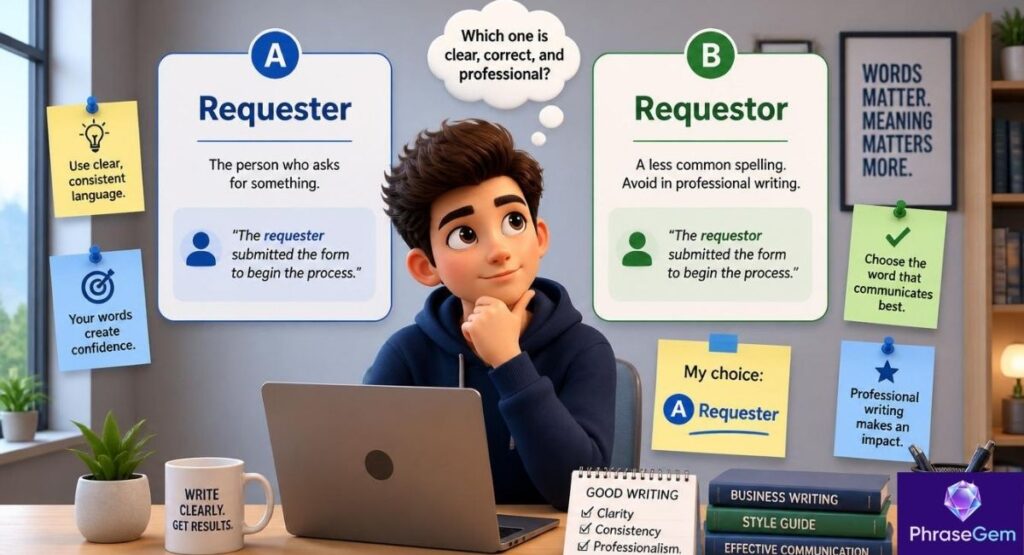
Go with requester almost every time. It is correct, natural, and accepted everywhere.
Use requestor only when:
- You are filling out a government or legal form that uses it
- The contract or document already uses “requestor”
- Your industry standard (IT procurement, law) requires it
Still unsure? Use requester. Nobody will question it.
Bonus Section: Short Polite Variations You Can Use
These work great in emails, support tickets, and professional writing:
- “The person who submitted the request”
- “Whoever made this request”
- “The individual who raised this”
- “The team or person requesting this”
- “As the one who submitted this request”
These sound natural, avoid any spelling debate, and work in both formal and casual writing.
Final Writing Tips
Keep it simple and consistent throughout your document. Do not switch between “requester” and “requestor” in the same piece of writing.
- Default to requester in all general writing
- Use requestor only when the document requires it
- Never use both in the same document
- Match the style of the platform or system you are writing for
- When writing for SEO or AI search, use requester as it is the more searched and recognized term
Read Next : 27+ Other Ways to Say “I Will Let You Know” (With Examples)

Elliot Fairmont is a language enthusiast and content writer at PhraseGem.com with a passion for making English easier to understand. He specializes in English grammar, phrases, vocabulary, text slang meanings, and everyday communication. Through clear explanations and practical examples, Elliot Fairmont helps readers improve their language skills, expand their vocabulary, and communicate with greater confidence in both personal and professional settings.
When he’s not researching language trends and writing educational content, Elliot Fairmont enjoys reading, exploring modern communication styles, and discovering new ways to make learning English simple and engaging.