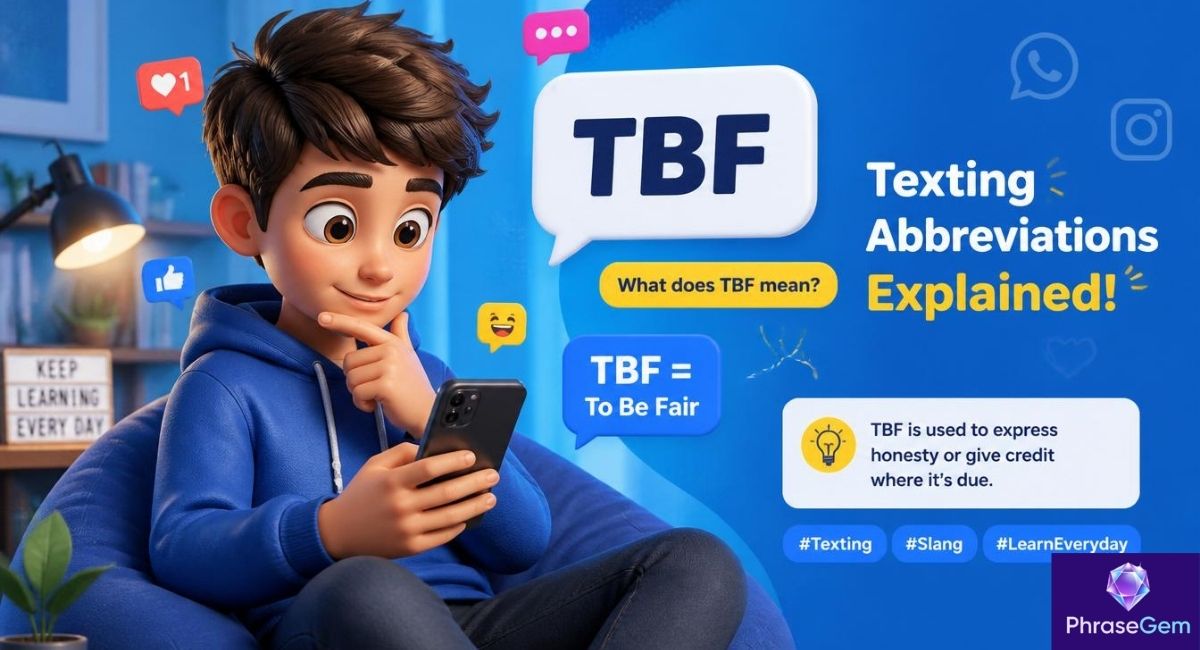
You’re reading a text and someone drops “TBF” mid-conversation and you’re just staring at your screen trying to figure out if they’re agreeing with you, defending someone, or lowkey calling you out. It happens in WhatsApp arguments, TikTok comment sections, and group chats at least a dozen times a day. TBF meaning in text confuses more people than you’d think, and using it wrong can make you sound out of touch or send the completely wrong signal.
This article breaks down exactly what TBF means, where it came from, and how people use it across different platforms and moods. You’ll get real chat examples, common mistakes to avoid, and a full list of similar expressions sorted by tone and situation. By the end, you’ll know not just what TBF means but when to use it, when to skip it, and how to respond when someone sends it your way.
TBF Meaning in Text – Quick Meaning
TBF stands for “To Be Fair.” You use it when you want to be honest, balanced, or give someone or something a fair chance in a conversation.
Quick Examples
“TBF, he did try his best.” “TBF, the movie wasn’t that bad.” “TBF, I would’ve done the same thing.”
Origin & Background of TBF
TBF started spreading in the early 2010s with the rise of texting and social media. It grew popular on Twitter, Tumblr, and later Instagram and TikTok. People needed a quick way to say “okay, but let’s be fair here” and TBF fit perfectly.
TBF vs Similar Slang Confusion Fix
| Slang | Meaning | When to Use |
| TBF | To Be Fair | Balancing an opinion |
| TBH | To Be Honest | Sharing a personal truth |
| NGL | Not Gonna Lie | Admitting something real |
| IMO | In My Opinion | Giving your view |
TBF is about fairness. TBH is about honesty. They feel similar but TBF usually defends or balances a point.
Real-Life Conversations Using TBF
WhatsApp Chat Example
“She cancelled again.” “TBF, she has been really sick lately.”
Instagram DM Example
“That photo didn’t get many likes.” “TBF your last post got way more reach, the algorithm is just weird rn.”
TikTok Comment Example
“This recipe looks too complicated.” “TBF it only takes like 20 mins once you try it.”
Text Message Example
“He never texts back fast.” “TBF he works night shifts, give him a break.”
Emotional & Psychological Meaning Behind TBF
When someone uses TBF, they’re usually trying to calm things down or stop someone from being too harsh. It shows empathy. It says “hey, let’s look at the whole picture before judging.” It’s a soft, mature way of handling a conversation.
TBF Grammar & Sentence Placement
TBF works at the start, middle, or end of a sentence.
“TBF, that was a tough situation.” “That was, TBF, not his fault.” “He did a pretty good job, TBF.”
Most people place it at the beginning to set the fair tone right away.
How TBF Is Used in Different Contexts
Social Media Usage On TikTok and Twitter, TBF is used to push back gently on popular opinions or defend someone being criticized online.
Example: “TBF the director had a really small budget for that film.”
Friends & Relationships Between friends, TBF softens disagreements and shows you’re not fully taking sides.
Example: “TBF, both of you were wrong in that argument.”
Work or Professional Settings TBF is mostly casual slang. Avoid it in formal emails. But in a team chat or Slack message, it’s totally fine.
Professional Example: “TBF, the deadline was moved at the last minute, so the team did well.”
Casual vs Serious Tone
Casual Tone Light and easy. Used in everyday chats. “TBF, pizza at midnight is always a good idea.”
Serious Tone Used to defend someone or correct an unfair judgment. “TBF, she was never given the same opportunities as everyone else.”
Common Misunderstandings About TBF
Mistake 1: Thinking It Always Means Agreement TBF doesn’t mean you fully agree. It means you’re adding balance. Example: “TBF, I don’t love his music but I respect the work he puts in.”
Mistake 2: Using It Sarcastically Sarcastic TBF can confuse people in text since tone is hard to read. Example: “TBF, that was the worst plan ever” can sound mean without context.
Mistake 3: Using It in Very Serious Situations Avoid TBF in deeply serious conversations like grief, trauma, or major conflicts. It can sound dismissive.
| Situation | Use TBF? |
| Casual debate | Yes |
| Defending someone online | Yes |
| Formal email | No |
| Serious emotional talk | No |
Key Insight: TBF works best when you want to add fairness, not win an argument.
Variations and Similar Expressions of TBF
1. TBH — To Be Honest More personal and direct than TBF.
2. IMO — In My Opinion Softer way to share a view without sounding pushy.
3. NGL — Not Gonna Lie Used when admitting something surprising or awkward.
4. Fair Point A spoken alternative when someone makes a good case.
5. Technically Speaking More formal, used when correcting facts.
6. Honestly Simple and direct replacement for TBF in most cases.
7. From Their Perspective Longer form of what TBF is trying to say.
8. Looking at It Fairly Full sentence version, more formal.
9. To Be Real Slightly more intense than TBF, implies deeper honesty.
10. If We’re Being Fair Conversational alternative used in spoken English.
How to Respond When Someone Uses TBF
Casual Replies “Yeah, TBF you’re right.” “Okay that’s actually fair.” “Can’t argue with that.”
Funny Replies “TBF… still not forgiving them though.” “TBF but also… nah.”
Mature & Confident Replies “I see your point, TBF I hadn’t thought of it that way.” “That’s a fair take, I respect that.”
Private or Respectful Replies “TBF I think we both need to think this through.” “You’re right, TBF that was on me too.”
Regional & Cultural Usage of TBF
Western Culture Very common in the UK, US, and Australia. The UK especially loves TBF as a casual phrase in everyday speech.
Asian Culture Used mostly in English-speaking online spaces. Less common in native language conversations but growing among Gen Z.
Middle Eastern Culture Appears in English digital chats, especially on Twitter and gaming communities.
Global Internet Usage TBF is universal on the internet. If someone is typing in English anywhere in the world, TBF is widely understood.
Tone Indicators With TBF
Tone matters a lot with TBF in text. Without emojis or context, it can sometimes feel cold or dismissive. Here’s how to make it land better:
Add a softener: “TBF though, she really did try 😅” Use it with warmth: “TBF, I’ve made the same mistake too.” Avoid it when emotions are high because fair logic doesn’t always comfort upset people.
TBF is one of those slang terms that sounds small but carries a lot of social weight. Use it to bring balance, not to brush off feelings.
Frequently Asked Questions (FAQs)
What does TBF mean in a text message?
TBF means “To Be Fair.” People use it to balance an opinion or defend someone in a conversation.
How do you use TBF in a chat?
You put TBF at the start of a sentence when you want to add a fair point. Like “TBF, he did apologize.”
Is TBF the same as TBH?
No. TBF means To Be Fair and TBH means To Be Honest. TBF balances a point while TBH shares a personal opinion.
What does TBF mean on Instagram or TikTok?
On Instagram and TikTok, TBF is used in comments to defend someone or push back on an unfair opinion gently.
Can you use TBF in a serious conversation?
It’s better to avoid TBF in serious or emotional talks. It can come across as dismissive when feelings are involved.
Where did TBF come from?
TBF became popular in the early 2010s through texting and social media platforms like Twitter and Tumblr.
Does TBF always mean you agree with someone?
Not always. TBF means you’re being fair, not that you fully agree. You can still disagree while using it.
Is TBF used only in English speaking countries?
TBF started in the UK and US but now anyone texting in English around the world uses and understands it.
What is a good reply when someone texts you TBF?
You can reply with “yeah that’s fair,” “can’t argue with that,” or simply “true” to keep the conversation smooth.
Is TBF okay to use at work?
Avoid TBF in formal emails. In casual work chats or Slack messages it is fine and sounds natural.
Conclusion
TBF is one of those small texting phrases that carries more weight than it looks. Whether you’re using it in a WhatsApp argument, a TikTok comment, or a casual group chat, it helps you sound balanced and fair without writing a long explanation. Once you understand how it works, it fits naturally into your everyday digital conversations.
Next time someone sends you TBF in a message, you’ll know exactly what they mean and how to respond. You now know the meaning, the tone, the right situations, and even the common mistakes people make with this slang term. Use it when it fits, skip it when emotions are high, and you’ll come across as someone who communicates with both confidence and fairness.
Read Next : 31+ Top Alternatives to “It Was a Pleasure Meeting You” for Emails & Conversations

Elliot Fairmont is a language enthusiast and content writer at PhraseGem.com with a passion for making English easier to understand. He specializes in English grammar, phrases, vocabulary, text slang meanings, and everyday communication. Through clear explanations and practical examples, Elliot Fairmont helps readers improve their language skills, expand their vocabulary, and communicate with greater confidence in both personal and professional settings.
When he’s not researching language trends and writing educational content, Elliot Fairmont enjoys reading, exploring modern communication styles, and discovering new ways to make learning English simple and engaging.