Saying “I appreciate it” three times in one email starts to sound like you ran out of ideas. Whether you’re thanking a colleague for staying late, replying to a client who came through for you, or texting a friend who showed up when it mattered, the same phrase every time makes your gratitude feel automatic.
Overusing it does not make you sound thankful. It makes you sound like you stopped thinking. There are so many other ways to say “I appreciate it” that actually fit the moment.
This article gives you 28 fresh alternatives, each with real examples, tone guidance, and clear usage tips. The phrases are sorted by situation so you know exactly which one to use at work, in personal conversations, or in formal writing. Read through, and you will never reach for the same tired phrase again.
What Does “I Appreciate It” Mean?
“I appreciate it” is a polite way to say thank you.
It shows you genuinely value what someone did for you, not just their words but their effort or kindness. It feels warmer and more sincere than a plain “thanks.”
When Should You Use These Alternatives?
Use alternatives when “I appreciate it” starts to feel repetitive or doesn’t match the moment.
A casual chat needs something like “that means a lot,” while a work email calls for “I truly value your help.” Match the phrase to the mood and the person.
Is “I Appreciate It” Formal or Informal?
It works both ways. You can say it to your boss or your best friend, and it fits naturally.
That said, in very formal writing like legal or official letters, a phrase like “I sincerely appreciate your assistance” sounds more polished.
28+ Other Ways to Say “I Appreciate It”
There are many warm and natural ways to say “I appreciate it.” Each phrase fits a different mood, relationship, or situation.
Whether you’re writing an email or texting a friend, choosing the right phrase makes your gratitude feel more real and personal.
1. Thank you so much
Meaning: A warm and enthusiastic way to express deep thanks.
Tone: Friendly and sincere
Do: Use it when someone goes out of their way for you.
Don’t: Overuse it in the same conversation, or it loses its weight.
Tip: Add a reason after it to make it feel more personal. “Thank you so much for staying late.”
Examples:
- Thank you so much for helping me move.
- Thank you so much, I really needed this today.
- Thank you so much for remembering my birthday.
- Thank you so much for covering my shift.
- Thank you so much for your kind words.
2. Much appreciated
Meaning: A short and polished way to say you are grateful.
Tone: Semi-formal and professional
Do: Use it in emails or quick replies when you want to sound put-together.
Don’t: Use it in emotional or deeply personal moments. It can feel too casual.
Tip: Works great at the end of a professional message as a closing line.
Examples:
- Much appreciated, I’ll get back to you soon.
- Your patience is much appreciated.
- The update is much appreciated, thank you.
- Much appreciated for sending that over quickly.
- Your help on this project is much appreciated.
3. I truly appreciate it
Meaning: Saying you genuinely and deeply value what someone did.
Tone: Warm and heartfelt
Do: Use when you want to stress that your thanks are real, not just polite.
Don’t: Use it for small or routine things. Save it for moments that matter.
Tip: The word “truly” adds emotion. It tells people you actually mean it.
Examples:
- I truly appreciate it. This helped me so much.
- I truly appreciate it, you didn’t have to do that.
- I truly appreciate it more than words can say.
- I truly appreciate it, you’ve been so supportive.
- I truly appreciate it, thank you for being there.
4. Thanks a lot
Meaning: A casual and friendly thank you that shows real gratitude.
Tone: Informal and relaxed
Do: Use with friends, family, or colleagues you’re close to.
Don’t: Use it sarcastically as it can come across as rude or passive-aggressive.
Tip: Keep your tone warm and genuine, so it never sounds sarcastic.
Examples:
- Thanks a lot for driving me home.
- Thanks a lot, I owe you one.
- Thanks a lot for being so understanding.
- Thanks a lot for the birthday surprise.
- Thanks a lot for fixing that issue so fast.
5. I’m grateful for it
Meaning: Expressing that something has touched you and you hold it with gratitude.
Tone: Genuine and thoughtful
Do: Use when someone’s support had a real impact on your life or work.
Don’t: Use it for minor favors. It carries emotional weight.
Tip: Pair it with a specific reason to make it land even more sincerely.
Examples:
- I’m grateful for it, truly from the heart.
- I’m grateful for it, and I won’t forget your kindness.
- I’m grateful for it more than you know.
- I’m grateful for it, you made a tough week easier.
- I’m grateful for it, your timing was perfect.
6. Many thanks
Meaning: A brief and polished expression of gratitude often used in writing.
Tone: Formal and professional
Do: Use in professional emails, letters, or business communication.
Don’t: Use in casual texts or conversations. It can sound stiff or old-fashioned.
Tip: It works perfectly as a sign-off line at the end of emails.
Examples:
- Many thanks for your quick response.
- Many thanks for attending today’s meeting.
- Many thanks for your continued support.
- Many thanks for reviewing the document.
- Many thanks for your time and consideration.
7. I can’t thank you enough
Meaning: Your gratitude is so big that words can’t fully express it.
Tone: Emotional and deeply sincere
Do: Use in moments of real impact, like when someone helps you through something hard.
Don’t: Use it for everyday small favors. It will feel overdramatic.
Tip: This phrase hits hardest when said in person with genuine eye contact or emotion.
Examples:
- I can’t thank you enough for everything you’ve done.
- I can’t thank you enough for being there that night.
- I can’t thank you enough for your advice.
- I can’t thank you enough, you changed everything.
- I can’t thank you enough for your support during this time.
8. Much obliged
Meaning: A classic and slightly old-fashioned way to say you feel a sense of grateful duty.
Tone: Formal and traditional
Do: Use in formal settings or when you want to sound distinguished and respectful.
Don’t: Use with younger people or in casual chat. It can sound awkward or out of place.
Tip: Great in formal written communication or historical style writing.
Examples:
- Much obliged for your assistance, sir.
- Much obliged for the introduction.
- Much obliged, I’ll return the favor soon.
- Much obliged for your time today.
- Much obliged for making this arrangement possible.
9. I value this
Meaning: Saying that what was given or done holds real worth to you.
Tone: Sincere and thoughtful
Do: Use when the gesture, feedback, or help truly matters to your work or life.
Don’t: Use it too quickly or it may sound rehearsed.
Tip: It works really well in professional settings when someone shares feedback or an opportunity.
Examples:
- I value this feedback more than you know.
- I value this chance to work with your team.
- I value this connection we’ve built over time.
- I value this kind of open and honest communication.
- I value this opportunity you’ve given me.
10. Thanks, I really appreciate it
Meaning: A double-layered thank you that adds warmth and emphasis.
Tone: Friendly and genuine
Do: Use when you want to go a step beyond a plain “thanks.”
Don’t: Use it so often that it becomes your default response to everything.
Tip: The combo of “thanks” and “appreciate” makes the gratitude feel extra real.
Examples:
- Thanks, I really appreciate it, you saved my day.
- Thanks, I really appreciate it, that was so thoughtful.
- Thanks, I really appreciate it more than I can say.
- Thanks, I really appreciate it, you didn’t have to do this.
- Thanks, I really appreciate it, this means the world to me.
11. I appreciate your help
Meaning: Directly thanking someone for the specific help they provided.
Tone: Warm and professional
Do: Use it when someone actively did something to help you solve a problem.
Don’t: Use it when no real help was involved. It should be specific and earned.
Tip: Mention what the help was for to make it feel more personal and less generic.
Examples:
- I appreciate your help with the report.
- I appreciate your help in getting this done on time.
- I appreciate your help navigating this process.
- I appreciate your help, things are clearer now.
- I appreciate your help, this project couldn’t have moved without you.
12. Thanks for taking the time
Meaning: Acknowledging that someone gave up their time for you, which is valuable.
Tone: Respectful and professional
Do: Use when someone spent time answering questions, reviewing work, or meeting with you.
Don’t: Use it when the task was quick or didn’t require real effort on their part.
Tip: This phrase shows maturity and respect. People love to hear that their time is valued.
Examples:
- Thanks for taking the time to explain this.
- Thanks for taking the time to meet with me today.
- Thanks for taking the time to review my work.
- Thanks for taking the time to respond so thoroughly.
- Thanks for taking the time, I know your schedule is packed.
13. I owe you one
Meaning: A light and friendly way to say you’ll return the favor someday.
Tone: Casual and playful
Do: Use with friends or colleagues in relaxed settings.
Don’t: Use in formal or professional emails. It’s too casual and informal.
Tip: Follow it up with something specific like “coffee’s on me” to make it feel genuine.
Examples:
- I owe you one for covering that meeting.
- I owe you one, seriously, thank you.
- I owe you one, you’re always there when I need you.
- I owe you one for helping me fix that bug.
- I owe you one; let me know when I can return the favor.
14. I’m thankful
Meaning: A simple and honest statement of gratitude that comes from the heart.
Tone: Gentle and sincere
Do: Use when you want to express calm and genuine thanks without drama.
Don’t: Use it alone without context. Add a short reason to make it feel complete.
Tip: Simple words said sincerely often hit harder than long, complicated phrases.
Examples:
- I’m thankful for everything you’ve done for me.
- I’m thankful you were there at the right moment.
- I’m thankful for your honesty and your time.
- I’m thankful to have someone like you in my corner.
- I’m thankful, truly, from the bottom of my heart.
15. I’m very appreciative
Meaning: A slightly more formal way to say you are full of appreciation.
Tone: Polite and professional
Do: Use in professional settings or when writing a thank you note.
Don’t: Use it in casual texting. It can sound stiff or over-formal.
Tip: Works well in job interviews or after receiving career help or mentorship.
Examples:
- I’m very appreciative of your guidance.
- I’m very appreciative of the opportunity you’ve given me.
- I’m very appreciative of your time and patience.
- I’m very appreciative of everything your team has done.
- I’m very appreciative of your kind and thoughtful response.
16. Thanks a million
Meaning: An exaggerated and cheerful way to say a very big thank you.
Tone: Upbeat and enthusiastic
Do: Use with friends or in lighthearted moments when you’re truly delighted.
Don’t: Use in formal or serious contexts. It sounds too playful for professional settings.
Tip: It’s fun and energetic. Use it when you want your thanks to feel like a celebration.
Examples:
- Thanks a million, you really came through for me.
- Thanks a million for organizing everything so perfectly.
- Thanks a million, I couldn’t have done this without you.
- Thanks a million for being so generous.
- Thanks a million, you’re the best person I know.
17. I appreciate your efforts
Meaning: Recognizing the hard work and energy someone put into something for you.
Tone: Professional and respectful
Do: Use when someone worked hard, even if the result wasn’t perfect. Effort deserves credit.
Don’t: Use it in a way that sounds like you’re brushing off the result while thanking the effort.
Tip: This phrase is great for team settings and performance feedback conversations.
Examples:
- I appreciate your efforts on this challenging project.
- I appreciate your efforts to meet the deadline.
- I appreciate your efforts in making this event a success.
- I appreciate your efforts even though things didn’t go as planned.
- I appreciate your efforts, it clearly shows you cared.
18. Thanks kindly
Meaning: A gentle and slightly old-fashioned way to say thank you with warmth.
Tone: Warm and somewhat formal
Do: Use in written communication or when you want to sound warm but composed.
Don’t: Use in fast-paced casual conversations. It may sound overly formal.
Tip: It adds a soft and polished touch to thank-you notes or letters.
Examples:
- Thanks kindly for your generous support.
- Thanks kindly for thinking of me.
- Thanks kindly for your reply.
- Thanks kindly, I’ll be in touch soon.
- Thanks kindly for going above and beyond.
19. I’m thankful for your support
Meaning: Expressing gratitude specifically for the emotional, practical, or professional support someone gave.
Tone: Heartfelt and sincere
Do: Use when someone stood by you through a challenge or gave ongoing encouragement.
Don’t: Use it for one-time small acts. It’s meant for meaningful and sustained support.
Tip: This is powerful in personal letters, speeches, or heartfelt messages.
Examples:
- I’m thankful for your support during this difficult time.
- I’m thankful for your support throughout this project.
- I’m thankful for your support, it kept me going.
- I’m thankful for your support both personally and professionally.
- I’m thankful for your support, it made all the difference.
20. I appreciate your time
Meaning: Thanking someone specifically for the time they gave you, which is one of the most valuable things a person can offer.
Tone: Respectful and professional
Do: Use after meetings, interviews, phone calls, or any situation where someone gave you their time.
Don’t: Use it in contexts where time wasn’t really the main thing they offered.
Tip: Always a smart closing line in a professional email or after a job interview.
Examples:
- I appreciate your time today, it was very helpful.
- I appreciate your time and thoughtful feedback.
- I appreciate your time, I know how busy you are.
- I appreciate your time during this review session.
- I appreciate your time, I learned a great deal from our talk.
21. Thank you kindly
Meaning: A warm and courteous version of “thank you” with a gentle, old-fashioned charm.
Tone: Polite and gracious
Do: Use in situations where you want to sound warm and well-mannered.
Don’t: Use it in super casual conversations. It can sound a bit theatrical.
Tip: Works beautifully in handwritten notes or formal verbal exchanges.
Examples:
- Thank you kindly for your generosity.
- Thank you kindly for the lovely gift.
- Thank you kindly for your time and consideration.
- Thank you kindly, it was a pleasure speaking with you.
- Thank you kindly for your warm welcome.
22. I’m appreciative of this
Meaning: A direct way of saying that what you received holds real value to you.
Tone: Formal and composed
Do: Use in professional writing or when you want to sound polished and thoughtful.
Don’t: Use it in everyday speech. It can sound slightly robotic when spoken out loud.
Tip: Better suited to written messages than spoken conversation.
Examples:
- I’m appreciative of this opportunity to contribute.
- I’m appreciative of this thoughtful gesture.
- I’m appreciative of this level of detail in your response.
- I’m appreciative of this chance to collaborate with you.
- I’m appreciative of this, it truly means something to me.
23. This means a lot to me
Meaning: Saying that what someone did or gave you has deep personal meaning.
Tone: Emotional and personal
Do: Use when something genuinely touched your heart or made a real difference in your life.
Don’t: Use it casually for small things. It carries emotional depth and should be saved for real moments.
Tip: This phrase works best when said sincerely and slowly. Let the emotion come through.
Examples:
- This means a lot to me, thank you so much.
- This means a lot to me, especially right now.
- This means a lot to me, I didn’t expect this at all.
- This means a lot to me coming from you.
- This means a lot to me and I’ll always remember it.
24. I sincerely appreciate it
Meaning: A formal and heartfelt expression that says your gratitude comes from a genuine place.
Tone: Formal and deeply sincere
Do: Use in professional messages, cover letters, or when thanking someone for a significant act.
Don’t: Use it in casual or quick text conversations. It’s meant for more meaningful settings.
Tip: The word “sincerely” tells the other person you mean every word. Use it when you truly do.
Examples:
- I sincerely appreciate it and everything you’ve done.
- I sincerely appreciate it, your help was invaluable.
- I sincerely appreciate it, this was beyond what I expected.
- I sincerely appreciate it, your support carried me through.
- I sincerely appreciate it, thank you from the bottom of my heart.
25. I’m thankful beyond words
Meaning: Your gratitude is so deep that regular words can’t contain it.
Tone: Deeply emotional and powerful
Do: Use in moments of real impact, like after someone helps you through something life-changing.
Don’t: Use it for small or routine acts of kindness. It would feel overstated.
Tip: This phrase belongs in heartfelt speeches, personal letters, or deeply emotional moments.
Examples:
- I’m thankful beyond words for your kindness.
- I’m thankful beyond words for standing by me.
- I’m thankful beyond words for everything you sacrificed.
- I’m thankful beyond words, you’ve changed my life.
- I’m thankful beyond words, no expression feels enough.
26. Appreciated
Meaning: A short and direct one-word way of saying thank you.
Tone: Casual to semi-formal
Do: Use in quick replies, Slack messages, or informal emails when brevity is key.
Don’t: Use it in deeply personal or emotional moments. It’s too short to carry real warmth there.
Tip: Simple and clean. Works perfectly in fast professional exchanges when you don’t want to over-explain.
Examples:
- Appreciated, I’ll follow up shortly.
- Appreciated, great work on this.
- Appreciated, this is exactly what I needed.
- Appreciated, you made this so much easier.
- Appreciated, looking forward to working with you.
27. I appreciate it greatly
Meaning: Saying your appreciation is big and strong, not just surface-level.
Tone: Formal and emphatic
Do: Use when you want to add extra weight to your thanks in a professional setting.
Don’t: Use in casual chat. It’s a bit formal for relaxed conversations.
Tip: The word “greatly” adds power. It signals that the act was more than just helpful to you.
Examples:
- I appreciate it greatly, your input was incredibly valuable.
- I appreciate it greatly, this has helped me move forward.
- I appreciate it greatly, your advice was spot on.
- I appreciate it greatly, thank you for going the extra mile.
- I appreciate it greatly, your support was exactly what I needed.
28. Your support means a great deal to me
Meaning: Telling someone that the support they gave you carries real and deep personal value.
Tone: Warm, formal, and emotionally sincere
Do: Use in heartfelt messages, professional thank-you letters, or when wrapping up a meaningful relationship or project.
Don’t: Use it for quick or minor exchanges. It’s a phrase for significant moments.
Tip: This is perfect in closing paragraphs of thank-you emails or end-of-project acknowledgments.
Examples:
- Your support means a great deal to me during this transition.
- Your support means a great deal to me, and I don’t take it lightly.
- Your support means a great deal to me both personally and professionally.
- Your support means a great deal to me, thank you for never giving up.
- Your support means a great deal to me, I couldn’t have done this alone.
29. I’m deeply grateful for your help
Meaning: A strong and sincere expression of gratitude for real, meaningful help someone gave you.
Tone: Emotional and formal
Do: Use when someone helped you through something genuinely difficult or important.
Don’t: Use it for small everyday favors. It deserves to be saved for real impact.
Tip: “Deeply grateful” tells people the help reached you at a personal level. Use it when that’s true.
Examples:
- I’m deeply grateful for your help during the hardest time of my life.
- I’m deeply grateful for your help in making this project a success.
- I’m deeply grateful for your help, it changed everything for me.
- I’m deeply grateful for your help and your patience throughout.
- I’m deeply grateful for your help, words truly fall short here.
Formal Ways to Say “I Appreciate It” in Professional Settings
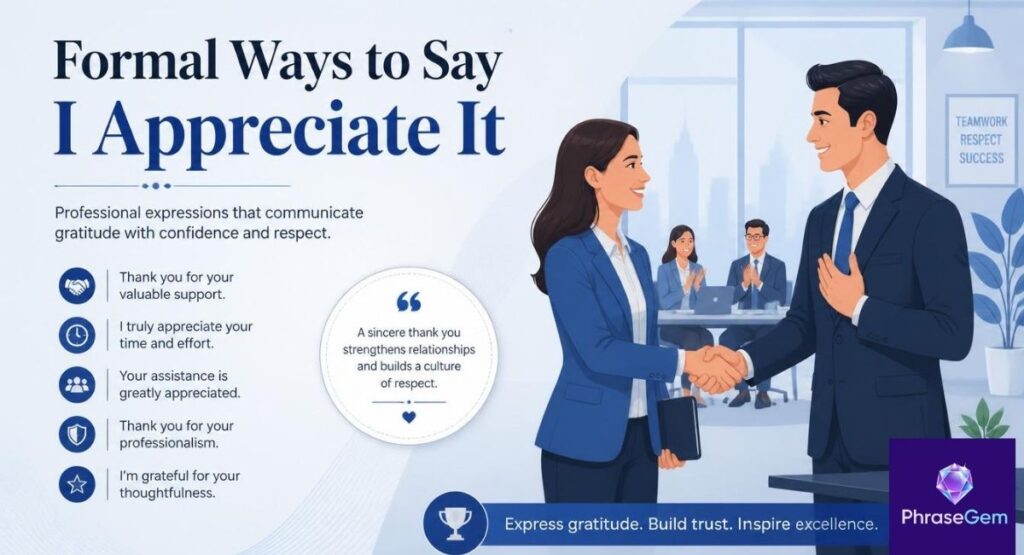
In professional settings, how you express gratitude matters. The right phrase can make you sound polished, respectful, and credible. Here are the best formal alternatives:
| Phrase | Best Used For |
| I sincerely appreciate your assistance | Emails and formal letters |
| I am grateful for your continued support | Long-term professional relationships |
| Your effort is greatly valued | Team and colleague acknowledgment |
| I truly appreciate your time and consideration | Meetings and interviews |
| I am thankful for your prompt response | Client and business communication |
Use these when writing to managers, clients, or anyone you want to impress with your professionalism.
Common Mistakes When Using “I Appreciate It”
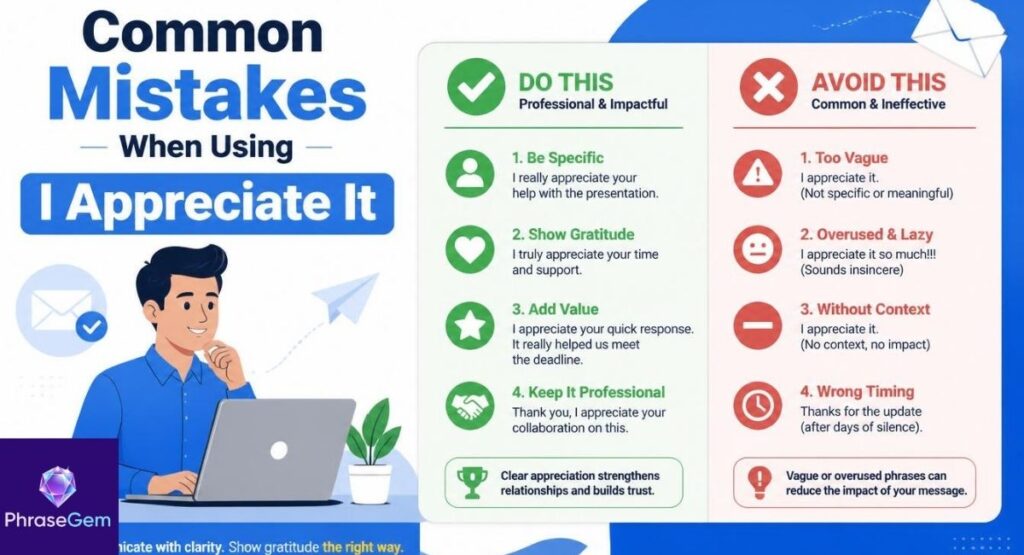
Most people say “I appreciate it” the right way but a few small habits can make it fall flat or feel fake. Here is what to avoid:
- Saying it too often. When you use it for everything, it stops meaning anything.
- Using it without context. “I appreciate it” alone can feel vague. Tell them what you appreciate.
- Wrong tone for the setting. Saying “thanks a million” in a formal email sounds unprofessional.
- Saying it sarcastically. Even small sarcasm ruins the whole message instantly.
- Being too generic. “I appreciate your help” hits harder than just “I appreciate it.”
The fix is simple. Be specific, be genuine, and match your phrase to the moment.
Final Writing Tips
- Match your phrase to the moment. A casual “thanks a million” does not belong in a formal email.
- Be specific. “I appreciate your help with the deadline” feels warmer than a plain “I appreciate it.”
- Say it at the right time. Gratitude lands best when it comes quickly, not days later.
- Mean what you say. People can feel when thanks is genuine and when it is just filler.
- Do not overuse one phrase. Rotate your expressions so they never lose their value.
- Keep it short and real. A simple, sincere line beats a long, overdone paragraph every time.
The goal is never just to sound polite. It is to make the other person feel truly seen and valued.
FAQs
What are other ways to say I appreciate it?
You can say “thank you so much,” “this means a lot to me,” “I’m grateful for it,” or “I truly appreciate it.” Each one fits a different mood or situation.
How do you say I appreciate it in a professional way?
Use phrases like “I sincerely appreciate your assistance” or “your support means a great deal to me.” These sound polished and respectful in work settings.
What is a more formal way to say I appreciate it?
“I am deeply grateful for your help” or “I sincerely appreciate your time and consideration” work well in formal emails and professional letters.
How do you say I appreciate it without sounding repetitive?
Rotate between phrases like “this means a lot,” “I’m thankful beyond words,” or “I value this” so your gratitude always feels fresh and genuine.
What is a casual way to say I appreciate it?
“Thanks a lot,” “I owe you one,” or “thanks a million” are great casual options for friends, family, or close colleagues.
How do you express gratitude in one word?
“Appreciated” works perfectly as a one-word reply, especially in quick messages, emails, or Slack conversations.
Read Next: Other Ways to Say “It Was a Pleasure Working With You”: 29 Professional Alternatives

Elliot Fairmont is a language enthusiast and content writer at PhraseGem.com with a passion for making English easier to understand. He specializes in English grammar, phrases, vocabulary, text slang meanings, and everyday communication. Through clear explanations and practical examples, Elliot Fairmont helps readers improve their language skills, expand their vocabulary, and communicate with greater confidence in both personal and professional settings.
When he’s not researching language trends and writing educational content, Elliot Fairmont enjoys reading, exploring modern communication styles, and discovering new ways to make learning English simple and engaging.