You got a TIA at the end of someone’s message and had no idea what it meant so you just replied with a thumbs up and hoped for the best. It happens more than you think. TIA meaning in text shows up everywhere in WhatsApp group chats asking for favors, in TikTok comments hunting for song names, and in work Slack threads chasing deadlines. Miss it once and the whole conversation feels off.
This article breaks down exactly what TIA means, where it came from, how it sounds in different situations, and when you should or should not use it. You will also see real examples from different platforms so you can start using it the right way starting today.
TIA Meaning in Text – Quick Meaning
TIA means “Thanks in Advance.” You say it when asking for help and already expect someone to come through for you.
Simple Definition
It’s a shortcut for saying thank you before someone even does the thing you asked. Short, warm, and saves time.
Quick Examples
“Can someone send me the notes? TIA!” “Need help moving Saturday. TIA guys.”
What It Communicates
You’re being friendly, showing confidence that help is coming, and keeping things light without sounding demanding.
Origin & Background of TIA
TIA came from early internet culture, forums, and email threads where people needed fast, polite ways to close a request.
How TIA Evolved
It started in tech forums and emails. Then moved to texting, then social media. Now it’s everywhere from Instagram to Slack.
Real-Life Conversations Using TIA
WhatsApp Example
“Hey can someone pick up drinks tonight? TIA 🙏”
Instagram DM Example
“Could you tag the creator of this? TIA!”
TikTok Comment Example
“Anyone know the song in this video? TIA”
Work Chat Example
“Please review the doc before 3pm. TIA”
Text Message Example
“Can you grab milk on your way? TIA babe”
Tone Variations in Real Use
TIA can sound casual, warm, slightly bossy, or even sarcastic depending on how you write it. Context does all the work here.
Emotional & Psychological Meaning Behind TIA
Why People Use It
It lets people ask for something while already sounding grateful. It removes the awkward gap between asking and thanking.
Social Psychology Behind It
Using TIA creates a small social contract. You’re trusting someone before they act, and that actually makes them more likely to help.
Emotional Tone Matters
TIA with an emoji feels warm. TIA in a cold work message can feel like pressure. Same word, very different energy.
Usage of TIA in Different Contexts
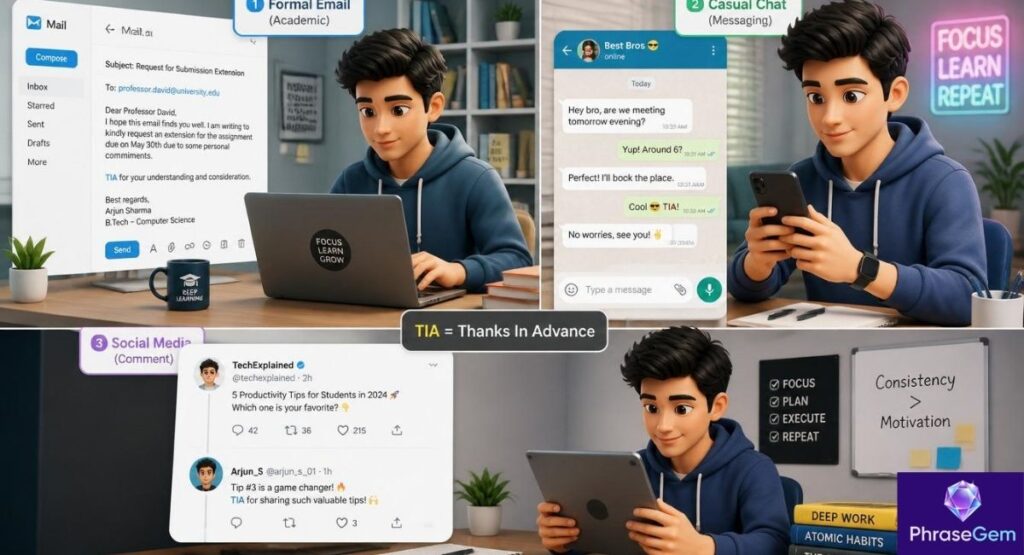
Social Media Usage
Common in comment sections when asking for sources, credits, or recommendations.
Friends & Relationships
Very natural and casual. Adds a light, appreciative touch to everyday requests.
Work & Professional Settings
Works fine in casual Slack or team chats. Avoid it in formal emails to clients or senior leadership.
Best Professional Use
Use it with teammates, not bosses or clients unless your workplace culture is very relaxed.
Casual vs Serious Tone
Casual: “TIA bestie 💕” Serious: “Please send by EOD. TIA.” (feels borderline pushy)
Common Misunderstandings About TIA
1. Thinking TIA Has Only One Meaning
In medical terms, TIA means Transient Ischemic Attack (a mini stroke). In older slang, it meant something else entirely. Always check the context.
2. Assuming It Always Sounds Polite
In some messages it can feel passive aggressive, especially when paired with a demand and no real warmth.
3. Using It in Very Formal Situations
Never send “TIA” to a professor, new client, or in a job application. Use “Thank you in advance” written out fully.
4. Overusing It
If every message ends with TIA, it loses meaning fast and starts to sound like you expect everyone to do things for you.
Comparison Table
| Version | Tone | Best Used |
| TIA | Neutral | Casual chats |
| TIA! | Friendly | Friends, group chats |
| Big TIA | Warm | When someone helped a lot |
| TIA Everyone | Group-friendly | Team or community asks |
| Massive TIA | Very grateful | Big favors |
| Thanks ahead of time | Semi-formal | Work emails |
Key Insight: The more effort you put around TIA, the warmer it sounds. Alone it’s efficient. With context it feels genuine.
Variations & Related Types of TIA Usage
1. TIA
The basic version. Clean and quick.
2. TIA!
Adds energy. Feels more friendly and enthusiastic.
3. Big TIA
Used when the favor is larger or more meaningful.
4. TIA Everyone
Great for group chats or community posts.
5. TIA for the Help
Slightly more specific and genuine sounding.
6. TIA Guys
Casual and warm. Common in friend groups.
7. Advanced Thanks
More written out. Still informal but slightly more effort.
8. Thanks Ahead of Time
Full phrase version. Works in semi-professional settings.
9. Appreciate It in Advance
Warmer tone. Feels less transactional than TIA alone.
10. Massive TIA
For big requests. Shows you know you’re asking a lot.
How to Respond When Someone Uses TIA
Casual Replies
“No worries!” / “Got you!” / “On it!”
Funny Replies
“You already thanking me? Bold move 😂” / “TIA accepted lol”
Mature & Confident Replies
“Happy to help, I’ll get that to you soon.”
Private or Respectful Replies
“Of course, sending it now.”
Real Short Chat Breakdown
Jake: “Can you cover my shift Friday? TIA man” Sam: “Yeah I got you, no stress”
TIA set a friendly tone. Sam matched it. Done.
Regional & Cultural Usage of TIA
Western Culture
Very common in the US, UK, and Australia. Standard in casual digital communication across all age groups.
Asian Culture
Used widely in English-speaking online spaces. In local languages the full phrase is preferred in most contexts.
Middle Eastern Culture
English-speaking users adopt it naturally online. Formal settings still prefer complete phrases out of respect.
Global Internet Usage
TIA is one of the most universally understood internet abbreviations. Works across platforms and countries wherever English is used casually.
Proper Grammar + Sentence Placement
Put TIA at the end of your message, not the beginning.
✅ “Can you send that file over? TIA!” ❌ “TIA can you send that file over?”
It works as a standalone closer. You don’t need a comma before it but you can use one if the sentence is longer. Keep it lowercase or uppercase, both work fine in casual settings.
FAQs About TIA Meaning in Text
What does TIA mean in a text message?
TIA means “Thanks in Advance.” You use it when asking someone for help and thanking them before they even do it.
How do you use TIA in a conversation?
Just put it at the end of your request. Like “Can you send me that file? TIA!” and you’re done.
Is TIA rude or polite?
It’s usually polite and casual. But if your message sounds demanding, TIA can feel a little pushy without extra warmth around it.
What does TIA mean on WhatsApp?
Same thing. It means “Thanks in Advance.” People use it in group chats or personal messages when asking a quick favor.
Can I use TIA at work?
Yes, but only in casual team chats or Slack. Avoid it in formal emails to clients or senior management.
What is the full form of TIA in texting?
The full form is “Thanks in Advance.” It’s a quick way to show gratitude before someone helps you out.
Does TIA have any other meaning?
Yes. In medical terms TIA stands for Transient Ischemic Attack which is a mini stroke. Always check the context before assuming.
Is TIA used on Instagram and TikTok?
Absolutely. People drop TIA in comments when asking for song names, product links, or creator credits.
When did people start using TIA online?
It started in early internet forums and emails. Over time it moved into texting and then spread across all social media platforms.
What is the difference between TIA and thank you?
“Thank you” comes after help is given. TIA comes before. It’s a way of expressing gratitude in advance while making a request.
Conclusion
TIA is one of those small texting shortcuts that carries a lot of weight. It keeps conversations warm, saves time, and shows gratitude before someone even lifts a finger to help. Once you understand how it works across different platforms and tones, using it feels completely natural.
Just remember context is everything with internet slang like TIA. A casual chat with friends hits different than a professional message to your manager. Use it right and it builds a friendly, appreciative vibe in your digital communication. Get the tone wrong and it can feel passive aggressive without you even realizing it.
Read Next : 28+ Creative Alternatives to Say Happy Birthday in English

Elliot Fairmont is a language enthusiast and content writer at PhraseGem.com with a passion for making English easier to understand. He specializes in English grammar, phrases, vocabulary, text slang meanings, and everyday communication. Through clear explanations and practical examples, Elliot Fairmont helps readers improve their language skills, expand their vocabulary, and communicate with greater confidence in both personal and professional settings.
When he’s not researching language trends and writing educational content, Elliot Fairmont enjoys reading, exploring modern communication styles, and discovering new ways to make learning English simple and engaging.